First of all an acknowledgement to @peatworrier whose blog earlier in the week started me in this direction and with whom I appeared on Newsnight Scotland to discuss the legal issues involved on Wednesday past.
There has been some publicity over the last few days over the stated intention of various Yes Campaign organisations to register with the Electoral Commission as "permitted participants" in the Independence referendum and thus subvert the campaign spending limits supposedly in place.
Having considered the legislation however my own impression is that, if this happens, it is likely to be more of a problem for Yes Scotland than an advantage and I below go on to explain why. In doing so I also readily admit a misapprehension of my own which caused an error in law in what I said when I appeared on Newsnight Scotland with the peaty one.
But first I had better set out the general framework surrounding Referendum campaign expenditure.
It is set out in the primary legislation, The Scottish Independence Referendum Act 2013 and particularly Schedule 4 thereto.
Essentially the broad intention is to cap what can be spent on either side.
There is an anticipation that there will be a main campaign organisation on either side, now confirmed as Yes Scotland and Better Together respectively. They are given a total spending limit of £1,500,000 each. In addition it is recognised that political parties have a special role in the process so they are entitled to spend a fraction of another £3,000,000 calculated with reference to their vote at the last Scottish Parliament elections. Thus, for example, the SNP can spend £1,344,000; Labour £834,000. Since, including the Greens in the Yes column, pro and anti independence parties more or less tied the 2011 election, the net effect is a broad equality of permitted spending on both sides.
But then we have the additional element: "Permitted Participants".
A permitted participant is somebody (an individual or a body corporate) who wishes to attempt to persuade voters to vote one way or the other and to spend more than £10,000 in the process. If they register with the Electoral Commission they are allowed to do just that subject even then to a spending cap of £150,000. Failure to register but incurring expenditure anyway constitutes a criminal offence. As does, needless to say, exceeding the cap.
The "controversy" surrounds the suggestion that various Yes Scotland front organisations propose to register as Permitted Participants and thus boost the spending available to the independistas.
Before going on to deal with this issue, I should concede that the Yes Campaign does not have a few genuinely independent allies. Like them or laugh at them, National Collective is in nobody's pocket. That would require a degree of coherence to their activities. Even more so Women for Indy, who indeed are so outwith the control of Yes Scotland Central that the Nats appear to have set up a rival Mums for Change organisation to be more on message. If NC or WfI register and spend money they would find no quarrel from me. Indeed I might be tempted to give National Collective some dosh myself.
But, it has been obvious for some time that Yes Scotland is running a pastiche "Obama for America" campaign. They even use the same basic colour scheme. One of the features of, particularly, the first historic Obama campaign, was various groups "for Obama". Veterans for Obama; Seniors for Obama; Students for Obama etc. And one of the features of Yes Scotland has been a similar plethora of supposed interest groups either "for Yes" or "for Indy".
But the USA is a country of 300 million inhabitants. Scotland is not. So the number of actual people meeting the qualifying criteria for these groups in a country of 5 million has been limited and the problem has been solved by effectively allowing anybody to claim to be a supporter. Thus you can support "Farming for Yes" even if you don't have so much as a garden and indeed a quick look at the twitter page of "Grannies4Indy" reveals a surprising number of middle aged men among their 424 followers.
Then we have the notorious examples of Business for Scotland with its alleged 1800 members, 1740 of whom appear to prefer to remain anonymous and many of the remaining sixty who are not businesses or even business people at all. Or Labour for Indy, which was revealed by the press to be largely "SNP Councillors pretending to be Labour" for Indy and eventually forced to confess that it was not a grass roots organisation but rather an astroturf one largely funded by Yes Scotland.
All's fair in love and politics I suppose. So long as no attempt is made to maintain these are in any way stand alone organisations. They are no more independent of Yes Scotland than United with Labour is independent of the Labour Party.
But, and I accept it is a but, if they attempt to register independently with the Electoral Commission will this give the Yes side a spending advantage anyway?
Here's where the law, and the possible problem for Yes Scotland, kicks in. This is a bit boring but stick with me.
Here is paragraph 20 of Schedule 4 to the Scottish Independence referendum Act.
20 (1) This paragraph applies where—
(a) referendum expenses are incurred by or on behalf of an individual or body during
the referendum period,
(b) the expenses are incurred as part of a common plan or other arrangement with one
or more other individuals or bodies,
(c) the common plan or arrangement is one whereby referendum expenses are to be
incurred by or on behalf of both or all of the individuals or bodies involved in the
common plan or arrangement with a view to, or otherwise in connection with,
promoting or procuring one particular outcome in the referendum, and
(d) there is a designated organisation in respect of each of the possible outcomes in
the referendum.
(2) Subject to sub-paragraph (4), the expenses referred to in sub-paragraph (1)(a) are to be
treated for the purposes of paragraphs 18 and 19 as having also been incurred by each of
the other individuals or bodies involved in the common plan or arrangement.
(3) This paragraph applies whether or not any of the individuals or bodies involved in the
common plan or arrangement is a permitted participant.
(4) Where a designated organisation is involved in the common plan or arrangement, the
expenses referred to in sub-paragraph (1)(a)—
(a) so far as—
(i) incurred by or on behalf of an individual or body that is not a permitted
participant, and
(ii) the total amount of such expenses incurred by or on behalf of that
individual or body does not exceed £10,000,
are to be treated for the purposes of paragraphs 18 and 19 as having been incurred
only by the designated organisation,
(b) so far as incurred by or on behalf of a permitted participant other than the
designated organisation are to be treated for the purposes of paragraphs 18 and 19
as having been incurred only by the designated organisation, and
(c) so far as incurred by or on behalf of the designated organisation, are not to be
treated for any purposes as having been incurred also by or on behalf of any other
individual or body.
Now, what does that mean? Just to clarify. A "designated organisation" is Yes Scotland (or conversely Better Together). A permitted participant is e.g. Business for Scotland. The key phrase is "a common plan".
If literature or advertising is undertaken by Business for Scotland with the consent or knowledge of Yes Scotland, or bearing the branding of Yes Scotland, then, no matter who actually pays for it, that expenditure [is] "to be treated as having been incurred by [Yes Scotland]".
And the stakes here are high. For failure to acknowledge expenditure incurred in a common plan (by either Yes Scotland or Better Together) on their eventual election expense return would leave the person signing that return facing a period in the jail.
So are the Nats really going to take that risk for a few pounds of spending advantage? Somehow I doubt it.
It seems to me instead that the legislation causes quite a dilemma for the SNP and Yes Scotland in a different way and that relates to expenditure by the SNP themselves. The SNP will undoubtedly be a permitted participant but they do not have a separate campaign organisation. There may be Green Yes but there is no "Nationalists for Independence" organisation.
There is only Yes Scotland.
Yes Scotland on whose board sits the Deputy Leader of the SNP and which has been described by Stan Blackley, its departed full time official as "little more than an SNP front".
So how exactly is any expenditure incurred by the SNP not going to be incurred in a "common plan" with Yes Scotland? This is more than an academic point because, in that eventuality, no matter who pays the bills, all of that expenditure will be deemed, by law, to have been incurred (para 20(4)(c) above) "only by [Yes Scotland]". So the SNP could find itself using up the allowable expenditure of Yes Scotland while struggling to legitimately access their own allowable expenditure!
This is, I concede, also an issue for our side but to nothing like the same extent. No matter what else one thinks of Better Together, it has an identity separate from the Major Parties supporting it and these Parties in turn have their own distinctive "brand" in a way which simply does not exist on the other side. Politically that might even have been the Yessers intention (although I doubt it) but legally it is a problem.
Far be it for me to offer unsolicited legal advice but a good start would be to get Nicola off the Yes Scotland Board and replace her with someone not so obviously part of the SNP leadership. Any more advice would need to be paid for.
Postscript.
While on the telly as a result of a rushed misreading of Para 20 I suggested that any expenditure incurred in a common plan was deemed to be expenditure in full of both (or however many) participants in the plan. It is in terms of Para 20(2) but I had failed to appreciate the terms of Para 20(4)(c) creating an exception to that principle which applies (only) where one of the participants is a designated organisation.
Addendum (Added 3rd May).
Since first blogging this Peter Russell (@planet_pedro) has helpfully copied me in to an exchange he has had with the Electoral Commission on the potential consequence of one or other side being found to have exceeded the spending limits. Not only might those responsible be liable to criminal penalties, the result of the Referendum itself could be set aside by Judicial Review. All the more reason I think for Yes Scotland not getting up to any dodgy practices.
Friday, 2 May 2014

Monday, 28 April 2014
A Huge Meet
What do you see in this picture?
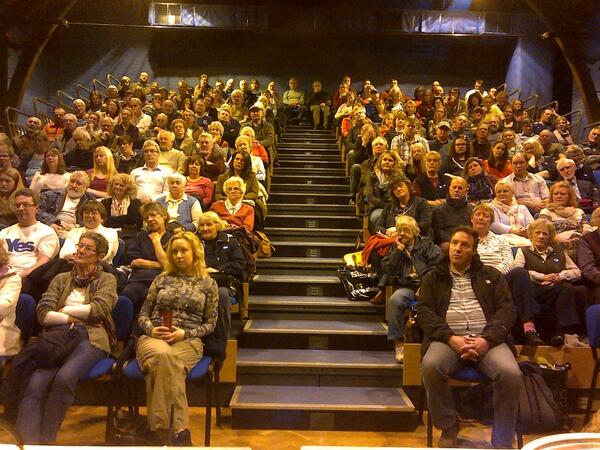
I'd say somewhere between 100 and 150 people.
Now why do I ask that question?
Because Ken Gowans, who is apparently an SNP Councillor for Inverness South posted it on twitter with the claim that he had been delighted to chair "a huge meet" (for Yes) and offering this as pictorial evidence.
Now, I like a good, Labour organised, "public" meeting as much as the next Labour person. It allows us to "rail" against the Tories or the SNP dependent on the nature of the event. But we don't lose sight of the "us" in that. For the "us" invariably includes the vast majority of the audience. It is unlikely any Tories or Nationalists will be there to be railed against in person, or at best they will only be there to rail back. It is even less likely that any members of the general public will be in attendance: partly because they don't particularly warm to railing; partly because if they really want to watch railing they can easily find some superior quality railing on the telly; but chiefly because they are not that interested.
Now there will be exceptions. Citizens who attend such events to inform the rest of the audience that we are all being poisoned by the fluoride in the water or indeed that Princess Diana is still alive and being held captive by the SAS/Mossad/the Martians (delete to taste).
We recognise that as the price of democracy. Or at least as the price of "public" meetings.
But for at least thirty years, sophisticated political movements have clocked that, while "public" meetings might have a role in cheering up your own activists, they have literally no impact on the wider public. That's not to confuse them with televised rallies. Such events do have a (limited) role but only for the very reason that they will be televised. Even then, they are fraught with the "Sheffield" potential.
Which is why I am genuinely bemused as to the strategy of Yes Scotland in this regard. To find (let's be generous) 150 people in Inverness interested in going to a public meeting apparently addressed not only by Fergus Ewing and Dennis Canavan but also by the leader of the SNP group on the local Cooncil and a woman called Michelle Thomson is not a remarkable achievement. After all, 72,000 people live in Inverness. What is remarkable is the delusion that being able to attract one person in five hundred from the local population is somehow something to boast about. And that's even before you include the faithful from elsewhere who no no doubt also attended, perhaps genuinely interested to hear from prominent members of their own side, but also "inadvertently" apparently "swelling" the number of actual Invernessians truly present.
I was amused by a photograph two or three weeks back of a similar public meeting in Renfrew, equally "huge" and equally boasted of with a photo on twitter. For it featured prominently among the audience a pal of mine, wee Brian Lawson. Now, I've known Brian since school. We enjoy to this day a mutual devotion to St Mirren football club where we will pass the time quite amicably. But Brian is not a member of the public; he is the leader of the SNP Group on Renfrewshire Council! So if he really needs to be persuaded to Yes then Nationalists are in even more trouble than I realised.
And, by the way, Brian is not from Renfrew. He is from Paisley. That's why he supports St Mirren.
Yet these "public" meetings are clearly not isolated events. Robin McAlpine boasted in the Scotsman last week that in the previous month he had addressed eighteen such events. Dennis Canavan on twitter announced he was to do another five in the next fortnight.
Now, on one view, all of this is harmless. No doubt if we could line up a few Better Together luminaries for a public meeting in Kilsyth I would toddle along myself.
The difference is that as I sat with my comrades from the Labour Party in the audience, even, for the occasion, showing some goodwill to the few local Tories and Libs also no doubt in attendance, I wouldn't for the moment delude myself that I was among the "public".
For the public would be at home watching Eastenders or the football.
There is however something slightly worrying about the reaction of some to these Yes Scotland jamborees.
It is developing a cult of the "true believer", already getting wound up by the idea that "so many" people have attended these meetings that defeat on 18th September will in some way be not a true expression of the "will of the nation".
So, if I did have one final thought it might be this. That there must be a resolution among the more sensible of those organising these events to remind their audience that Scotland will speak at the ballot box on September 18th. And that, once we have, that will be the end of it.
Sunday, 13 April 2014
My take on Eck
Alex Salmond had a historic opportunity yesterday. And he failed to live up to it.
Now, you would expect me to say that . for it is no secret that I am no admirer. But even I would concede that it is an achievement for him to have brought his country to a position where, to paraphrase Jim Sillars, between 8am and 10pm on 18th September, it has its sovereignty in its own hands.
As it will.
And I do not dismiss the observation that, as much as I personally am now a "No to dissolution" man as I would have been a "Yes to the union" man in 1707, this year I, like every citizen of Scotland, will have an opportunity to express a view. In the way that "the likes of me" had no say back at the beginning of the 18th Century. Indeed, one of the few advantages of this whole baleful episode will be to shoot down forever the argument that "Scotland never voted for the Union."
Yesterday, however it was for the man leading the counter argument to make his final pitch. To rise above the day to day and to paint a broader vision. Instead, Eck opted largely for boilerplate and calculation. You'd almost have thought he already knew this was only now about firing up a core vote.
For, while the speech started well, with a few well observed jokes at my side's expense, as it went on it became increasingly clear it was addressed to the already converted.
Let's be honest. Even if Scotland was to be the fourteenth most prosperous country in the developed world, while the UK was only the eighteenth, nonetheless Scotland would face choices. All taxes could not be lower while all public services were better. People are not daft. Very few, even in that hall, believe that a Scottish Government would not face tough decisions just as a British Government faces tough decisions. Indeed even as the German Government does.
And people also understand that politicians twist the facts to their agendas. They understand that in his heart David Cameron is for lower taxes and all its consequence while Ed is for better public services whatever the cost.
Thus they understand that, in a Scottish context, that Alex Salmond would be for an independent Scotland no matter what the price. He need reassure the public that it is affordable but he'll never credibly persuade them that the cause of his life arises from some sort of economic analysis he did as a schoolboy.
So surely it would have been better to acknowledge that and then to suggest why the electorate should agree. And a key element of that would have been to argue why that was the right choice NOW even if tacitly conceding that those to be persuaded of it now had not necessarily been wrong in their past views. And that has to be posed strategically: not based on abolishing the bedroom tax or getting rid of recent increased charges to lodge an Employment Tribunal claim.
This is what he could have said.
"This year we pay homage to those who founded this Party eighty years ago. Without them we would not be here today. But we also have to acknowledge that, over that eighty years, what we understand by independence has changed. This Party was founded in the aftermath of a cataclysmic world war and while the world was still divided into armed camps. Today, we are privileged to live in a Europe, in the west at least, where the idea of the use of force to resolve our disputes is a thing of the past.
The Party was founded when the idea of being a true Scot meant that you would be white and, let's be honest, protestant. Today we acknowledge those of many skin colours, and of many religions and none, who are fully equal members of our wonderfully diverse society.
It was founded by those who's overwhelming priority was Scotland itself, perhaps sometimes losing sight of the fact that there were other equally worthy causes. For wider social and political progress; to confront and defeat poverty; to secure true equality for women and ethnic minorities and, perhaps in a way some of us have only fully come to appreciate in the last ten years, to recognise that who you love cannot always be defined in traditional ways.
Without these pioneers of eighty years, as I say, we would not be here today but equally without our more recent recognition that independence can only succeed as part of a wider progressive movement would we now be standing on the verge of finally achieving their, and our, ultimate goal.
So I say to those concerned for a fairer society; your cause is our cause. For those wishing women to be full members of our community; your cause is our cause. For those wishing equality for all, regardless of race, gender or sexual orientation; your cause is our cause.
We believe, we have always believed that Independence is the best vehicle to achieve that. You have trusted us with the conduct of the devolved settlement over the last seven years and I believe we have served you well in that capacity. But how much more could we have done with full sovereign powers?
For about one thing the pioneers of eighty years ago and we in this in this hall today have been constant. That decisions affecting the people of Scotland are best taken by the people of Scotland. Not because we won't make mistakes. We will make mistakes.
But because the interests of every nation are best served by being controlled by the people who live there.
For the astonishing thing about Scotland is that it exists at all, That after more than three hundred years of union with a much larger neighbour we are still recognisably a Country of our own in every sense but the fully democratic one.
Going forward, beyond September 18th we will bear malice to none. We will continue to be a good neighbour and a responsible world citizen. When it is in our mutual interests to do so, we will continue to pool and share resources, and decision making, across this island, across Europe and indeed with all other democratic nations across the world. And we acknowledge that along the way some of that will need compromise.
We only ask that we be allowed to do so by our own calculation and not at the dictate of others.
We only ask to be a normal country. Scotland."
Now, that is what he could have said. Instead the speech was placed at the centre of a tableau which began with a dramatic performance of a play specially written by a man of well established anglophobic view; was then followed by two men with beards and guitars singing patriotic songs and was rounded off, after the oration itself, with the rendition of a dirge about a battle seven hundred years ago.
And backgrounded by a downward clicking clock that seemed to portend not opportunity but doom.
And the speech itself contained no real vision. Just rather repetitive rhetoric for the already converted and a clunky tokenistic "promotion" of two women to the cabinet in a crude attempt to address the yawning gender gap in the opinion polls.
Moses may have lead his followers to the top of the mountain but he seemed clueless as to how to get them to the promised land.
The next SNP Conference, postponed to November, will prove the test as to whether there can be a Joshua generation.
To stick with an Old Testament analogy however, my money would be more on Cain and Abel as a likely precedent for that event.
Thursday, 10 April 2014
Had I the heavens' embroidered cloths
This is an odd blog. I know that people who follow this site
do so because they wish to be outraged (on one side) or reassured (on another)
about the Scottish Independence issue.
But it is my blog. I don’t do fancy graphics or easy to
follow links or back references.. I just say what I think. Take it or leave it.
And I know that even my political opponents were taken aback
when I wrote this. To confess to where my personal circumstances were.
And in its aftermath I was appreciative of the sympathy I received across
the political divide.
But, in the real world, life went on. I went to my work every day. Tried, at least,
to secure justice for my clients. And tried
at least as importantly, to make money.
If not for myself then at least to secure the wages of those who work with me.
And all the while I was pretty miserable about the hand fate had dealt me
but resigned to it.
Until about six weeks ago.
I defy anybody who has been married forever, as I have been,
not to meet somebody and think “if only”.
So, about, ten years ago, such a person walked into my
office. A wee dark woman. If you follow me on twitter you will know I like wee
dark women. And when her legal business
was done, by circumstance, we still would bump into each other. And she’d smile
at me and pass some time and I’d (much less attractively) do the same. And I’d think again “if only”.
While wee Mo, who I will love to the very end, descended
further and further into the pit which is Alzheimers disease. Until Mo didn’t know who I was, except that I
was a familiar face.
So, after some very mild flirting over twitter, I wrote to
my (second) wee dark woman. And I told
her what I could and couldn’t offer and invited her to walk away.
Except she didn’t.
She saved me instead.
We’ve been out no more than ten times. First to hear the Scottish
Chamber orchestra play Schubert and Mozart, where she turned up ludicrously
overdressed and then let me laugh with her. Then to the Burrell that Sunday where
she suggested I might want to spend more time looking at the Bellini (I did)
and where she in turn nearly cried( I noticed) when, by coincidence, a chamber group played her favourite music
from Hungary. (She is Hungarian, did I mention that?)
Through La Boheme and Nardini’s at Largs and, after a Friday
night off, because I had a Law Society
Dinner , to Edinburgh and the Museum of Scotland and then the (wonderful)
refurbished National Portrait Gallery. With lunch at the Outsider in between (No
need to applaud).
And then, a week later, to the New Lanark Mill Hotel Cottages where we
marvelled at the beauty of my own country and I cooked her dinner and then we
watched the telly together. And then I marvelled simply at the beauty of her.
And then, then. the
ordeal of meeting her two teenage boys. Two
big lumps. Well actually one quite dashing but the other at least for the
moment just a lump but about whom I was reminded of a certain Danny Kaye
song. And going to see the film they had
chosen: “Need for Speed”. If there has been a worse film ever made then I have
not seen it. But then it is a very long
time since I was a teenage boy. They thought it was so brilliant they were
prepared to allow me to snog their mum afterwards. (briefly).
So, anyway, after a weekend out
together shopping at the Glasgow Market and then IKEA, as a result of
which I missed the West Ham against
Liverpool game for love, this woman and I appear to have become an item.
So much so that next week we are going to Hungary to stay
with her parents: to make her boys happy to see their grand-parents (even at
the expense of my company) but most importantly of all so that she and I might
be together for a week.
So, twitter is odd. From time to time you think something you
don’t quite understand might be going on beneath the radar.
Don’t speculate tonight. The use of “this woman” was unfair. For her name is Andrea Eperjes. She is
@AndiMecBandi
on twitter and I love her in a way I never thought I would ever love
again.
Sunday, 30 March 2014
There is no room for complacency!
Last Wednesday Liverpool played Sunderland in the Premier League. Liverpool are a much better team than Sunderland and by early in the second half were 2-0 up. Then, with twenty minutes to go, Sunderland scored a goal completely against the run of play. Despite being still the much superior team, Liverpool panicked. For the next quarter of an hour they looked as if they might throw the game away. Because while Sunderland had little to lose, Liverpool were challenging for the title and for the moment their nerves got the better of them.
As it turned out, by the final stages, both sides were just playing out time before settling for the home win outcome most had predicted before kick off.
I found myself thinking about this in the context of this weekend's bizarre wobble by the Better Together Campaign.
Obviously we were taken aback on Friday by the most spectacular of own goals by the unnamed Government Minister's comments in Saturday's Guardian but, to be honest, on reflection, the very proposal of "Trident for a Currency Union" betrayed someone who might think themselves to be a key player but who clearly doesn't understand Scottish politics at all. Indeed once the dust has settled it will be noticed that it was Nicola Sturgeon herself who immediately ruled out such an arrangement. So the Currency Union idea is as dead as it always was.
That doesn't mean that the culprit should not be found and made an example of. The assumption, it appears, by the Prime Minister that this will all blow over if it is ignored, is a fundamentally mistaken one. A percentage point or two could undoubtedly be lost if the Nationalists can maintain there is any uncertainty on whether we retain Sterling.
But my target tonight are others who are genuine allies. I have no idea why the Lib Dems decided to launch an outright attack on Better Together at their Conference. I know they might be scarred by their continued electoral rejection but we and the Tories are not. I'll come back to that. From Tavish Scott's suggestion that a man who barely retained a single mainland Scottish Parliament seat was best placed to advise the rest of us on electoral tactics; through Charlie Kennedy's spontaneous appeal for more big hitters when we've been trying for months to get him to do some more hitting himself; to the culmination in Alistair Carmichael's "doomed, doomed" finale, I am simply at a loss as to what they thought they were up to here. Might I suggest that they would have been better employed in persuading their own Party's former functionaries not to be assisting the enemy by defecting to the Yes Campaign?
And as for the Daily Mail! I know they have to sell Newspapers. Even I was alarmed to read, in the edition which I confess to having bought, that you might catch TB from your cat (and I don't have a cat). Nonetheless, the suggestion Better Together is in internal disarray is nonsense. It is not the No campaign which has had to dispense with most of its original personnel. There is good reason for that.
Now, on twitter, I amuse myself by the occasional observation that "There is no room for complacency!" But tonight I thought I should perhaps point out that actually there is quite a lot of room for that sentiment.
Firstly, we have the polls. Here they are. Look at the orange line (that's us) and then look at the blue line (that's them). What do you notice? The orange line is comfortably above the blue line in every case but one and even that one is a poll now accepted on both sides to be flawed in it's methodology. And what else do you notice? That this hasn't changed in a year.
Then we have real elections. The SNP won a local government by-election, retaining a safe seat, in Kilmarnock on Thursday. Congratulations to them. Particularly since it was the first by-election of any sort that they had won in the last eleven. And even then their vote dropped 9%. While the unwritten story of Scottish politics continued. That there was a major swing to the Tories. Now, it might be the case, as the SNP losing candidate in Cowdenbeath maintained with a, just about, straight face, that voters are embracing Nationalism while simultaneously abandoning the Nationalist Party. Somehow, however, I doubt it.
Then we have the school polls. School polls are interesting since they don't rely on adjustment by pollsters. There were another slew on Friday and again Nationalism was rejected by a margin of between to and three to one. Indeed, to the best of my knowledge, no secondary school of any proper size in the whole of Scotland has yet to vote Yes in such an exercise. Now, it might just be the case that the views of teenagers depart dramatically from the views of their parents and grandparents on this matter. Somehow, again however, I doubt it.
Then we have the "feel" of the ground troops. Those who are doing the telephone and street canvassing. Obviously I speak to more of ours than theirs. But I do speak to theirs. Ours admit to genuine bewilderment as to where this supposed, even significant minority, Yes vote is. At best, theirs insist they have "still got a chance" even while bemoaning the various factors (apathy, fear, the BBC) conspiring against them. It may be that they are completely deluded but I meet many in my Party concerned about what the Tory revival might mean for Edinburgh South or Dumfries & Galloway in 2015. I've yet to speak to anyone worried about losing a single Westminster seat to the SNP. And before anybody thinks these are just partisan mad bastards, many of these conversations concede that 2016 will be a much harder challenge than the UK General Election.
Then we have the argument, not on the policy but on its prospects, of our opponents. Chief among these is Mr Stephen Noon, who informs his observations with hints of secret polling known only to an elect of which he is one. I have no idea why this guy is taken seriously. Here is what he wrote on 27th April 2012, a week out from the local government elections in 2012. Either his "inside information" was seriously flawed or more likely he was just making it up. For we know the actual results of these elections.
"But let's remember 2011"! The Nationalists protest. "Look how we turned things round then"! As indeed they did. Credit where it is due. But in 2011 Scottish Labour ran the most incompetent election campaign of my lifetime. Possibly one of the single most inept election campaigns ever run by any Party, in any Country, at any time. I'll say no more than that. AND EVEN THEN, on a differential low turnout, with many of our voters staying at home in despair and many more Tories largely disinterested in Scottish Parliament elections, the SNP and their minor Party allies still did not secure a majority of the electorate for even having a referendum on independence, let alone on the proposition of independence itself.
So, here I turn my fire back on the Daily Mail. They might not like the politics of those at the heart of the Better Together Team because these politics are irredeemably Blairite. I'm no Blairite myself, albeit from a different direction.
But say what you like about Blairites, they know how to win elections.
So I finish where I started. With a football analogy. Today Liverpool played Spurs. Spurs are a much better team than Sunderland. But the Anfield jitters were gone and the five time European Champions ran out 4-0 winners. Comprehensively the better team from start to finish.
There is no room for complacency with regard September 18th. But only to the extent that we don't want the game remembered as Liverpool against Sunderland, even if we do end up playing out time for the last five minutes. We want it remembered as Liverpool against Spurs. Or, better still, Real Madrid against Eintracht Frankfurt.
Saturday, 22 March 2014
Together we can.
Busy, busy weekend so I suspect a shorter blog tonight. I was at the Law Society Dinner last night in the truly spectacular setting of the grand hall of the Museum of Scotland. My last one, as past Presidents only get five invites after their departure. How life moves on. A great sign off regardless.
Lots of interesting chat among the legal establishment but what happens at the Law Society Dinner stays at the Law Society Dinner. Sorry.
What's not a secret however is that it's a late night and the Society's hospitality remains generous so I wasn't exactly fizzing with energy when I set off early this morning for the Party Conference in Perth.
But on arrival there was enough fizz to make up for my own inadequacies on that front.
I've written before about Party Conferences in the aftermath of la grande debacle of May 2011. And they haven't been the cheeriest of events.
And my reservations mid-week about the intellectual coherence of Devolution Commission Report were clearly shared by others who I spoke to privately in and around the event. Although, to be fair, those who possibly thought it the greatest thing since sliced bread would hardly have sought out my company.
But, nonetheless, the Party seemed in remarkably good spirit. And this seemed attributable to three things.
Firstly, and this will I have no doubt lead to the usual "How dare they!" reaction from some of my readers, the assumption is that the referendum is over. Indeed, during the desultory pre big event debates somebody was even reduced to appealing from the platform with my own war-cry "There is no room for complacency"! But while Iain Davidson's metaphor that all that is left is bayoneting the wounded might have been better chosen, certainly in the presence of a mixed audience, it would be a lie to say that our activists are not looking forward with some enthusiasm to doing that bayoneting.
Secondly, oddly, there was a document, "Together we can." Everybody of any Party persuasion is used to glossy Conference Documents left thoughtlessly on seats or in pubs as the weekend proceeds and forgotten altogether by return to work Monday. Tomorrow's recycling. But this document is an exception. Many, many copies will have been packed carefully to take home. Well written, with simple statistics and easy to understand graphics, it is precisely the sort of crib that you would want before going out to knock doors. And, crucially, it is mainly about what Labour is FOR, after far too long defining ourselves simply in terms of what we are against. I don't know who wrote it but I take my hat off to them. It is, dare I say it, everything the Devolution Commission Report is not.
And finally, there was a speech. Not Ed's rather mundane effort on Friday. Not even a speech made to the actual conference. Rather a speech made on the fringe by Gordon Brown on a United with Labour platform. If I was asked once if I had seen it, I was asked half a dozen times.
The Scottish Labour Party loves Gordon Brown. And we grieve with him over his ill-starred occupation of the position he had aspired too for so long. For we, for the most part, aspired with him and on his behalf. But his reappearance now inspires within our rank and file an emotion which can only really be compared to Charlton Heston, in the title role, being strapped to his horse to lead the final charge at the end of El Cid.
Nobody could possibly think Gordon is too close to the Tories in the fight for the Union. And no half baked ideas among various middle class nationalist "creatives" could ever be held up with any credibility as being more motivated to assist the cause of working people than could be the life work of this man. No harm to Ed but immediately before Johann spoke there was an otherwise very good wee video made for us by Better Together. Various Scottish Party luminaries were cross cut with ordinary people pledging support for a No vote. Well made and well put together. But for the finale was...Ed. At the end people applauded politely. I say with absolute confidence however that if it had been Gordon who had appeared at that point rather than Ed then the conference would have not just applauded but cheered. And they wouldn't have waited to the end of the video to do that.
If you are not in the Scottish Labour Party I don't expect you to understand that, let alone agree with it. Just take it from me that it is true. It is a personal thing. We could have no better morale booster than Gordon being "back".
So, with these three great pillars to build on, it was over to Johann. Who didn't disappoint. There will be lots of press coverage tomorrow so I won't duplicate that. I am confident it will be generally positive. But there is no point in me analysing the speech in a way which might allow any mild criticism of a particular emphasis or momentary tone to detract from its overall achievement. Read it yourself. It is, read as a whole, very, very impressive.
I finish with one final observation. The Labour Party in Scotland might not yet be able, without dispute, to assert that it has recovered its former strength. But within the the Party itself there is no doubt that it believes, with increasing confidence, that it has. It is too early yet to talk of May '16 but in regard to May '15 the chat is already about East Dumbartonshire, Dundee East and even, possibly, Argyll and Bute.
Time will tell but, from this distance, I expect next year's eve of poll event to have a greater fizz still.
Tuesday, 18 March 2014
Thought for the day
Where to begin?
With the words of Oscar Hammerstein, placed into the mouth of Julie Andrews.
"Let's start at the very beginning, that's a very good place to start".
Scottish Labour has always been divided on the issue of Scottish Home Rule. Not Independence, it has been consistently opposed to Independence. Indeed, as I have already observed in an earlier blog, it was that very opposition which led to the formation of the SNP.
But on the question as to whether Scotland should have a devolved/federal/home rule assembly there has always been a difference of opinion. Sure, Keir Hardie was for it (albeit on the basis of the creation of a similar English "government" distinct from the "Imperial Parliament" at Westminster) So was Maxton. But it was no real priority for the first two (minority) Labour Governments in 1924 or 1929, whose most prominent Clydeside member, John Wheatley, had strong reservations about what the whole thing might mean for the Irish Catholic minority. Nor was a Scottish Parliament any part of the platform of our greatest ever Government from 1945 to 51 or of even any great interest to our greatest politician of that age, Tom Johnston. Indeed by the late 1950s it was official Labour Party policy to be positively opposed to the very idea of a Parliament (or whatever) sitting in Edinburgh.
But there has always, equally, been a counter tide. By the sixties and early seventies coalescing around the likes of George Foulkes and Jimmy Boyack and John P. Mackintosh but above all personified in Donald Dewar. Those who genuinely thought that a legal system without its own legislature was an affront to democracy and who, crucially, dismissed the idea that a Scottish Parliament need inevitably lead down Tam Dalyell's slippery slope to separation.
And in the middle there were those who didn't care much either way. Who subscribed to Herbert Morrison's dictum that "Socialism is whatever a Labour Government does" and whose only priority was to maximise the electoral chance of such a Government being elected. And, let's be honest, this middle ground were more motivated by the electoral success (or otherwise) of the SNP than any great point of principle either way.
So you have to understand that history before you go on to consider what has happened today.
If Labour had won the 2011 Scottish Parliamentary Election, there would never have been a Scottish Labour devolution commission. That is obvious. But it didn't mean that it wasn't an opportunity.
And, to be honest, I believe it was an opportunity missed.
Now, before I go on, I want to say two things.
The first is to say that I don't think today will make a scintilla of difference to the vote on September 18th. Anybody who protests that the incoherence of the proposals has persuaded them to vote for independence is lying. They were voting for independence anyway. The key message, that devolution is not yet at the "line in the sand" point, is the crucial one. We can sort out the real details beyond September 19th.
The second is that I have, for the avoidance of doubt, thought about whether I should keep my reservations to myself. If I thought they might have any influence on the referendum result I most certainly would have. But I don't. We already know the referendum result. What's left is just about the margin of victory.
But the document produced today is a complete mess. One of the major criticisms of the White Paper is that it confuses policy with principle. That's true. However compared to the Labour document it rivals the Constitution of the United States in its focus.
How can it possibly be the case that the Scottish Parliament has the right to vary taxes upwards but never downwards? Why is the law on misuse of drugs or abortion to remain reserved to Westminster and thus uniform across the UK? Why are we "devolving" the administration of Employment Tribunals but not the Employment Law they enforce? Why shouldn't we (have the right to) cut Air Passenger Duty? Now all of these outcomes might well constitute the policy platform on which Labour would seek (currently) to be elected (I'm certainly not for cutting any form of tax) but the point is THAT IS A MATTER FOR THE ELECTORATE, it is not something to be written into a constitutional settlement.
And as for the idea that the Scottish Parliament could not be abolished without its consent? Where to start. Certainly, even now, that would be politically unthinkable, but for that to be "outlawed" wouldn't be possible without ripping up the UK's unwritten constitution and starting again with a properly written one. For what it's worth, once again, I am personally for that but that constitution can't be written unilaterally by less than ten percent of the UK's population, let alone by one political Party within it.
Now, in terms of allowing Labour to posture as to being to the left of the SNP this document might just have some purpose. The idea that "the rich" might be squeezed till the pips squeak by us while the Nats squirm on the sidelines will undoubtedly allow us a bit of fun at the expense of the "radical" elements of the "Yes coalition". When however you consider that there are less than 13,000 of these additional rate taxpayers, earning more than £150,000, in the whole of Scotland out of more than two and a half million total income tax payers; and consider that there are far fewer still living in houses worth more than two million pounds, it doesn't take long to recognise this for what it is. Posturing.
The document is not a mouse but a mess. A document produced as a compromise between the three competing strands of Labour opinion I started with. It reminds me of.........the 1979 Devolution proposal with all ups and no downs for Labour. As I say, it won't, I suspect, have much bearing on the referendum either way but as for a way forward after 18th September? Never forget. It wasn't the 1979 scheme that came to pass but one devised by a cross party Constitutional Convention. That is surely, once more, where we would need to go.
Subscribe to:
Posts (Atom)