I was out today. I went down the coast and had a fish tea (actually a fish lunch) in Nardini's at Largs. I cannot praise that experience too highly.
And it got me thinking. Who are the Nardini? (no "s", that's the correct usage. Look it up.)
They are Italian immigrants. They came here from Barga, in the province of Lucca in Tuscany. And they worked hard. Very hard. All hours in chip shops and ice cream parlours until they could acquire the jewel in their crown. The art deco cafe that famously bears their name on the esplanade at Largs.
Now, I don't want to attribute to them political views but I will. For, with due modesty, I know many Scots Italians and all of them respect hard work and none of them want to pay any more taxes than they absolutely have to. They are business people. They want their children to do better than them and if they or these self same children succeed then they so no reason that the sweat of their labours should be siphoned off to support those"unprepared to make that effort".
And for the Italians of the twenties and thirties and beyond, you could just as easily substitute the Jews who had come before; the Pakistanis and Indians who came after; the Poles and Latvians who are coming now and indeed, I suspect, the Bulgarians and Romanians who are yet to come.
Certainly there will be those who fall by the wayside, by reason of illness or simply wider economic factors. Those who will be grateful, in time, for the British Welfare State. But many of those who succeed will inevitably fall back on the old saw "The Lord helps those who help themselves", whichever Lord they have in mind in that process.
And so these people should either be natural Tories or at least willing to consider that option.
It was the great, electoral, achievement, of Margaret Thatcher to appreciate that. Not for nothing was it observed that she transformed the fortunes of the Conservative Party by making it a Party as much for Estonians as it was for Etonians.
Yet somehow in Scotland that didn't happen. And, when you look back, the reason for that was that it lacked....diversity. The Scottish Conservative and Unionist Party remained a Party of middle aged white men. And their wives. Certainly often self made but most commonly self made going back several generations. Golfers, Freemasons, Kirk Elders. Whether there were even fewer Catholics than there were women would have made an interesting thesis.
And the element of diversity they were most almost unthinkingly hostile to was "the cause of Scotland". They were conservatives with both a small and capital "c". So the need for a devolved parliament was as difficult to sell to them as it would have been difficult to sell to Metternich in 1847 that perhaps Catholic Absolutism was an idea which had had its day. Thus we ended up with a situation where a man of such impeccable Tory credentials as Alick Buchanan-Smith was regarded as politically suspect by reason of believing in a Scottish Parliament and Malcolm Rifkind having to recant his earlier devolutionist views in order to prosper.
It has taken the Scottish Tories a long time to recover from that legacy. Indeed to the extent that they still have little ethnic minority support they still haven't recovered. How many of those in the, primarily anti-Labour, "Scots Asians for Independence" might be in Tory ranks had they played their earlier cards better.
But.
Sometimes Parties just get lucky. Labour got lucky when in 1983 particular local factors delivered the safe north-east seat of Sedgefield to a little known London Barrister with no previous connection to the seat. The Tories got lucky (although perhaps the lady made some of her own luck) when the indecision of their grandees saw Thatcher succeed Heath.
And I'm increasingly thinking the Scottish Tories might have got lucky in the aftermath of the 2011 Scottish election. All justice should have handed the succession to Murdo Fraser. His policy pitch was exactly right: that far from remaining implicitly hostile to devolution the Tories should positively advance it to go further and deeper. Only then could the Parliament have the financial accountability that would allow the centre right to prosper.
And Murdo had also done his time. An accomplished debater and public speaker, no one would be hiding behind the settee when he went head to head with Salmond or Johann. Of those time served in the Parliament, with no disrespect to the personable Jackson Carlaw, he was the only possible choice.
But there was another option. A complete leap in the dark. A young, gay, woman who had literally come from nowhere and who might conceivably have returned there. Sure, Murdo is entitled to feel aggrieved as to the "line in the sand" message that got her there but sometimes politics isn't fair. FDR was elected President of the USA on a promise to balance the Federal Budget! Who cares now?
Today, Ruth Davidson spoke to her Party Conference. And, afterwards, who would doubt that it is now truly her Party? And a Party about which you know where it stands and what it's priorities are.
Now I could pick holes in her message. For example, it is simply impossible to offer educational choice in much of rural Scotland. The task is not to make some schools better but all schools better. As it should be in urban Scotland as well. And as for her endorsement of Universal Credit! That's not really the point. She'll never get my vote. But I can see the attraction to others of the message. Not all of them Italian.
And it is a message with increasing traction. For buried in the small print of the speech is the fact that in eleven consecutive Scottish Parliamentary or local government by-elections the Tory percentage share has increased
In the end however the messenger was more important than the message. Oddly, Ruth is I think a Kirk Elder. She might even play golf. Although I doubt she is a Freemason. But she doesn't come across like that. She comes across as somebody who is living in the twenty-first century. Who just happens to be a Tory.
So I conclude with two observations. Firstly, there is a big election within eight months of 18th September. And while I don't doubt the ability of the Nats to put up a last ditch fight in May 2016, particularly if they hold back money from the referendum lost cause, it is difficult to see what their pitch will be the year before.That choice will be Cameron or Miliband. And, in its pursuit, from a Tory perspective, might I respectfully suggest Business for Scotland have already have provided a useful contact list?
And secondly? The most likely outcome in May '16 remains a nationalist victory but without an overall majority. In the end their people are more motivated to vote in a Scottish Parliamentary Election than ours. But if our Parties are agreed on much that needs to change in Scotland do we really need to sit about in collective opposition letting the Nationalists blame four more years of complacent inaction on the constitution? Couldn't we perhaps sort something out? Dare I say it, I suspect Murdo Fraser would make a formidable Finance Minister. Well to the left of John Swinney.
Sunday, 16 March 2014

Saturday, 8 March 2014
I've lost that blogging feeling

In honour of the season, here is one of my favourite Breugel's. "The Battle between Carnival and Lent." From the Kunsthistorisches Museum in Vienna. For it's significance you will need to read to the end.
You might have noticed that there was no blog from me last weekend.
In fact, I wrote a fair bit of a draft about the Ukraine, essentially suggesting that the post putsch regime in Kiev was not exactly the Liberal Democratic happy clappy bunch it was being portrayed in much of the media. That that while Russian military intervention was to be deplored, so was the idea that democratically elected governments could be unconstitutionally overthrown just because they were unpopular or even corrupt. And that countries generally could only be truly called democracies if all concerned accepted that any freely elected government had a legitimacy even if a critical part of its support came from an ethnic minority community. That either has to be accepted or the only logical alternative, an agreed fragmentation of the state, equally conceded.
At least a significant part of Ukrainian Nationalism seems to accept neither proposition. That while, to aspire to be part of the EU, they say (or at least they claim to say) that they wish to be a democracy, only a Ukrainian Nationalist administration, oriented away from Moscow, would ever, to them, be an acceptable outcome of that democracy.It shouldn't be up to the Russians alone to point out to them that they cannot have their cake and eat it in that regard.
And, finally, I was going to point out the parallel with a certain trend in more domestic nationalism. Certainly, Scotland has the right to self determination, but whatever way it chooses to exercise that right will be a valid exercise of that right. Arguing otherwise is in fact arguing against self determination, instead suggesting not self determination but rather the unilateral determination by one side alone. Even if it proves to be the minority side.
Anyway, I didn't get the blog done as I kind of wandered off into the research undergrowth of the shifting boundaries of eastern Galicia, best illustrated by the fact that Lviv/Lvov/Lemberg has been, in peacetime alone, in four different countries in the last hundred years. By the time I might have engaged in slash and burn editing on Monday to get the thing finished, that day's papers had been ahead of me in suggesting the Ukrainian situation was already appearing less black and white.
So, like the the onetime Polish-Lithuanian Commonwealth, my blog has been consigned to the dustbin of history.
But I'd enjoyed the exercise at the time. For at least it was a departure from finding something new to say about the Scottish Referendum in isolation from events in the wider world.
Where we increasingly all find it difficult to find something new to say. The polls aren't moving and neither are the Nats moving from their apparent belief that they don't need to, or possibly can't, do anything to shift them.
We've now seen an advance of their new poster campaign and it must be said that it looks like a desire just to go to a core vote strategy.
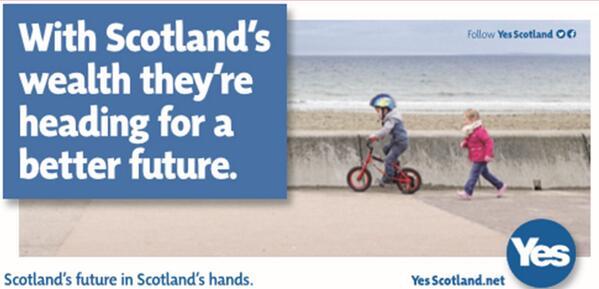
The "Scotland's Wealth" line will no doubt appeal to those who already believe in "Scotland's Wealth" (and that it is being stolen by the English) but the rest will I suspect regard it as no more credible than a suggestion that the accompanying photograph represents "Scotland's Weather".
That the campaign poster was leaked on twitter by someone on the inside of the Yes campaign to express their own annoyance at the bland message is of, I suppose, minor significance. As is the emergence of the occasional nationalist press or online comment along the lines of "Why we might (sic) lose" or indeed "No would not mean No". Their message is fraying at the margins.
But majority nationalist opinion is taking on a sort of sad recognition that, no matter how they got to this point, they are where they are. That the best they might now achieve is respectability but that even that is a still a cause worth pursuing. Most certainly, that while their project might be terminally ill, nothing is to be gained by prematurely commencing a post-mortem. Not least since it remains the only project they've got.
So we'll stumble on. With them occasionally hailing a rogue poll or the patently self-interested intervention of the likes of Willie Walsh as a "gamechanger", while we demonstrate public exasperation yet private glee over whatever next intellectual house on sand they ask Scotland to stand back and admire. In the world of real voters however both sides continue to gather more and more voter identification information pointing only to one decisive result. And fewer and fewer voters to be moved either way.
Good news for my side but not such good news in respect of finding material for my blog.
Maybe I should just go back to blogging about Art.
Which brings me back to the Breugel.
Pure dead brilliant.
Saturday, 22 February 2014
Hillhead (Part 3)
Before I go on and suggest any lessons it is only right that I recount the subsequent fate of the various participants.
Roy Jenkins became the MP for Glasgow Hillhead. He then led the SDP into the 1983 General Election where they came close to being second. After that he stood down as leader and in 1987 on new boundaries, he lost his seat, finally, to the Labour Party. His successor was George Galloway who many of us (myself included, I confess) thought should have been our candidate in 1982.
P. Gerald "Piggy" Malone became the Tory MP for (marginal) Aberdeen South in 1983, only to lose the seat to us in 1987. In 1992 he secured a safe berth in Winchester, but in 1997 lost that (very) safe Tory seat as well, albeit in bizarre circumstance. (look it up). Since then he has concentrated on making money. At least hanging never was brought back.
Dave Wiseman became a senior social worker and subsequently moved to Cumbernauld where I still occasionally encounter him in the car park at Tesco in a manner reminiscent of Robert Redford and Barbara Streisand at the end of "The way we were". He didn't ever find the Loch Ness Monster. At least as far as I know.
And the big loser of Hillhead? The woman under whose leadership the Tories had not only lost their last seat in Glasgow but had come close there to coming third? The by-election took place on 25th March 1982. On 2nd April, Argentina invaded the Falkland Islands. The rest is history. Or, if you are a Tory, legend.
But what of the wider political lesson? Why, despite all of the human resources that Labour had available to throw at the seat, had we not done better? Why hadn't all these voters who had packed in to these public meetings not then flocked to the polls? Because these voters never existed. Certainly the meetings were packed, but they were packed with Labour Party activists.
We were entirely speaking to ourselves.
And sure nobody at these meetings asked any awkward questions, or pointed out the obviously contradictory messages coming from the platform once one got beyond a common hatred of the Tories and contempt for the SDP. Because we had no interest in asking awkward questions of ourselves.
But, insofar as they attended these meetings at all, the undecided electorate noted that. And whether at such a meeting or more likely sitting in front of the telly, they were not inclined to vote for those who might be united (just) in what they were against but obviously in no way certain as to what they were for. And the more it became apparent that the partisans of Dave Wiseman and his Party were uncaring as to these obvious omissions, the more the electorate was inclined to distrust us with their vote.
I now could make all sort of comparisons with the Referendum Campaign. Alright, I will.
It seems almost every night I am currently besieged on twitter by Cybernat comment about how the "tweeter" has just come back from a brilliant meeting packed to the rafters where they have heard unanimous acclamation for the rhetoric of Jim Sillars, or Patrick Harvie or Colin Fox or Robin McAlpine or all four. Last week we were told that the new Academics for Indy group had attracted more than one thousand twitter followers within twenty four hours.
I don't doubt any (or at least most) of this.
But did anybody at these meetings ask Mr Harvie why, if his vision was so popular, his Party currently polls about one third of the Scottish support of UKIP? Or ask Mr Fox why his Party seemed to have abandoned electoral tests of popularity altogether? Or ask Mr Sillars why, if he believed the only
"Independence" prospectus currently on offer was "stupidity on stilts"we should nonetheless vote for it?
Or did anybody ask any of them at all where the women were?
Apparently not.
Just as nobody was interested in asking Academics for Indy how many of their immediate twitter followers were common to Farmers for Indy, Poles for Indy or Women for Indy while actually being neither academics nor farmers nor Poles nor even women? Rather simply being the same thousand or so Nationalist activists doing the internet rounds trying to give the impression of wider support.
Of course not. For there is nothing more comforting than being among one's own and believing that to be representative of wider opinion.
It might have been thirty two years ago but I knocked a lot of doors in Hillhead. And while I still remember the bluntness of Jimmy's speech his opinion itself, at the time, didn't surprise me.
I don't doubt, equally, that many Nationalist activists are also, in the modern age, making a lot of phone calls before they go out to be inspired from the public platform by Sillars, Harvie or Fox. And they'll know the results they are getting on the phone because it will, broadly, be the same results as we are getting.
And I suspect that, in their heart of hearts, they already know that. That when Peter Murrell is lifted onto his metaphorical table after the close of poll on 18th September, his message will echo that of Jimmy Allison all those years ago. That he is going home to his bed because he already knows the result.
Not that it will prevent them standing outside the count.
Hillhead (part 2)
The story so far is here
And so battle commenced.
In one way it followed the usual pattern. An introductory leaflet; The then compulsory plastering of every lamp post with a "Vote Labour" Poster. The organising of a Saturday "street presence" at all of the main shopping areas equipped with handouts for all voters, lapel badges for supporters and red balloons for weans of any political persuasion. And then the beginning of the attritional work of the door to door canvass with the results being transferred, still then manually, on to the "Reading system" sheets, ready for polling day.
But we were if anything too well resourced for this project and anyway this was "old" politics, engaging with voters only in a mechanistic way. Since internally the Party of that time was awash with meetings why not take these meetings to the public! For we were not short of great speakers.
So a series of public meetings were organised where Tony Benn, Dennis Healey, Neil Kinnock, John Smith and others addressed packed halls on the iniquities of the Tories and the treachery of the SDP. That was largely all they talked about since these were just about the only two matters on which we were united. We certainly didn't agree among ourselves about the merits or otherwise of the recently demitted Labour Government, let alone why it had been defeated. Or indeed about what economic policy should be pursued by the "incoming" Labour Government we believed the Country was nonetheless crying out for. And not just economic policy. On Europe, Defence never mind what should be the internal rules of our own Party, it would be fair to say that there was far from unanimity of opinion. Even when it came to the treachery of the SDP we weren't actually agreed on what this treachery was, with the Left maintaining it was the final evidence that these people had never been "Labour" at all, while the right felt that they had been abandoned by their former allies in the field. But, as I say, we were agreed they were treacherous and the Tories were evil and that seemed more than enough for these packed public meetings where, if questions were allowed at all, they seemed to consist of invitations to the platform to agree that something or other was particularly treacherous or particularly evil.
Meanwhile, back in the real campaign, the doorstep response was not perhaps proving all that it might have been. The main argument against Jenkins, that he would only ever pay any further attention to Glasgow if he won, did not seem in fact to be leading voters to the conclusion we wished. Indeed, if anything, quite the opposite. The fall back position, that he had abandoned the Labour Party also proceeded from the assumption that the elector agreed with the canvasser that this was a bad thing.
There was however clearly some distaste amongst the poshest of Tories at least for the politics of Piggy Malone. Unfortunately however that distaste did not extend to an alternative involving the closure of Glasgow Academy, let alone the overthrow of the entire Capitalist system.
It also, it must be conceded, didn't help when the Labour candidate, pressed for an example of a personal interest beyond his faithful participation in the rounds and rounds of Party meetings then required of any activist, revealed that he had devoted an earlier part of his life to attempting to prove the existence of the Loch Ness Monster.
But if you were a little anxious after a night's canvassing , as it became too late to disturb the electorate in their homes, you could always catch the end of one of these public meetings and console yourself that the number of unanswered doors earlier was probably because the voters had been out attending one of these events.
And so eve of poll. I was then a very young lawyer working in the Easterhouse area in the far east end of the city but still living in Paisley. So my journey home each evening involved only a minor detour to take me to the front line. On eve of a poll, as I had done for a fortnight, I headed straight from work to the main Labour Committee Rooms just off Dumbarton Road. To discover there was nothing to be done. Such were our resources that every last minute leaflet or knock up card was already in the process of being delivered. Every Mikardo sheet already filled in and pasted on to its table, Every polling station standing board already waiting by the door of the rooms to be put in place just before 7am.
"There must be something I can do" I protested. "Why don't you go to the eve of poll rally and swell the numbers" was the suggestion. And so I did,
Although, as it turned, out when I got to the Partick burgh Halls, the numbers didn't really need swelled. For the hall was, literally, full. So much so that an overflow event to be addressed by Brian Wilson had been set up in a building next door.
But I didn't want to attend any overflow event so I called in a favour to be found a standing place at the back of the balcony. The event was chaired by Alex Kitson, the great Labour and TGWU stalwart, and the main speaker to be Michael Foot himself. The hall was buzzing before a word was spoken and then things got better still. For in opening the meeting Comrade Kitson announced that he was privy to an opinion poll to appear in the following days Daily Telegraph. And that this poll predicted that Labour was on course to win the Hillhead by-election! At this the hall exploded. If the Red Flag was not sung spontaneously it might as well have been. It took about ten minutes for order to be restored. And then, without a single note, Foot spoke.
He spoke in that familiar, halting, manner of his. So outraged by injustice that he seemed sometimes to be struggling for breath. Excoriating the Tories and all their works, not just over the previous two years but for all of history, and then conjuring up the ghosts of Bevan, of the Red Clydesiders, of Keir Hardie himself to damn Jenkins and his followers for having abandoned the cause which remained truly the only hope of the World. Tomorrow we would show them what the people of Britain thought of them! What the people of Scotland thought of them! But, above all what the voters of Glasgow Hillhead thought of them! It was brilliant. I was crying. I don't mind admitting it, And I wasn't alone.
The evening, it must be admitted did not end quite so brilliantly when our local champion delivered a pre-written text, clearly written in anticipation of a different sort of audience and including within it an appeal for anyone to ask him in question they wished. There were none. For the only question anybody in that audience wanted the answer to was why couldn't the polling stations be opened immediately.
And polling day was brilliant as well, I was doing knock ups and as you went about the constituency it seemed every second person you met was a Labour activist. By about Eight O'Clock every single sheet: First knock up, second knock up, third knock up, fourth knock up on every single Reading Sheet had gone and we were reduced to knocking doors in known Labour areas where we had no actual canvass return but proceeded on the balance of probabilities.
At close of poll everybody piled into the committee rooms in numbers modern health and safety would never allow. Amidst the crush their was a cry for our general, Jimmy Allison, and he was lifted up to stand on a table. After the cheering died down he spoke.
He said all the usual things. Thanks to his fellow full time organisers (cheers). Thanks to the local Party volunteers involved in directing the campaign (cheers). Above all, thanks to all the activists from all over Scotland (more cheers), even Edinburgh (a few good natured boos), who had fought such a magnificent campaign. And then he said this. He knew many of us now intended to go and wait in the open air outside the count for the result as we had at Garscadden and Hamilton and Berwick. He would recommend against that. For we weren't going to win. Jenkins was going to win. We weren't even going to beat Piggy Malone for second place. Jimmy himself was going home to his bed and he suggested that we do likewise.
And with that he climbed down from the table.
We didn't take Jimmy's advice. We went to the count. But as the night wore on it was clear Jimmy had been right.
Why that was and what modern parallels and lessons might be drawn from it will be the subject of my third and final chapter.
Friday, 21 February 2014
Hillhead (Part 1)
I’ve written before about my favourite by-election.
Garscadden 1978. Because in the end
winning is essential to the complete experience.
But, at the time of the campaign, I had a better time still at
another by-election. In retrospect, a by-election from which I also
learned a good deal more. Hillhead 1982.
And, dare I suggest, lessons that others might yet learn
today.
I’m conscious that I am close now to writing history so I
need to provide a bit of setting, particularly for those under fifty or not
from the West of Scotland.
By the aftermath of the 1979 General Election, Glasgow Hillhead was the final Conservative seat
in Glasgow. Cathcart, stronghold of Teddy Taylor, last of the working class
Tories, had fallen to us as a consolation prize while Mrs Thatcher swept to
power.
But Hillhead was different. It wasn’t just posh in bits. It
was posh in really quite large bits. And its MP Sir Thomas Galbraith wasn’t
some poujadist like Teddy. He was a proper Tory. Member of Parliament since
1948; Baronet; Graduate of two Universities, importantly one of them Glasgow: served in the War; held various Offices of State
under McMillan, perhaps past his best but still someone whom it felt
disrespectful to vote against. “Tam” as he was universally known, had held on
against the steadily encroaching socialist tide. Until, in January 1982, he
suddenly and unexpectedly shuffled off his mortal coil.
And at what a point of opportunity for the Labour Party! For
the Tories were at their most unpopular EVER! (or so it seemed). Mrs T might have swept the country a mere eighteen months earlier but her mixture of populism and monetarism was
persuading nobody. Unemployment was
soaring and both her Party’s and her own popularity were plummeting. Even
significant sections of her own Cabinet were widely believed to think neither
she nor her policies were up to the job. If Labour couldn’t take Hillhead now then we
surely never would. Particularly since
the Tories selected as their candidate someone who could scarcely have been
more different from Sir Tam. P.G(erald) Malone. Known, by virtue of his initials,
as Piggy. An arraviste Thatcherite of the worst sort who announced that his
platform would be a combination of cutting unemployment benefit while bringing
back hanging. Bring it on!
But there was a fly in the ointment. For six months before,
the Gang of Four: Roy Jenkins (spit), David Owen (spit) and Bill Rogers (spit) together
with Shirley Williams (Please come back Shirley! Please. Even now) had been so
disillusioned with the infighting and toleration of ultra-leftism in the Labour
Party that they had left to form the SDP. And this was to be their first electoral
opportunity. So what better (for them) and more provocative (for us) than for
the new Party to see this as an opportunity to return their leader from
Brussels to the Commons? But what better
chance still for us to smother the infant Party in its cradle. Particularly as there
was scant evidence that Jenkins had ever previously set foot in Glasgow. Indeed. Bring it on (again)!
For on the eve of Battle, Labour felt it had assembled a
political fighting force equalled by nothing since Napoleon’s Grande Armee of
1812.
Hillhead might have been the poshest seat in Glasgow but it
also had, by some way, the largest active Party membership.* And not just any
membership. For it contained within its activist ranks most of the Scottish
Party’s Imperial Guard. Those who not
only ran the local constituency but indeed dominated the higher ranks of the Glasgow City
Party and even those of the Party’s Scottish
Executive itself. And that was before one considered the
others who resided in the Constituency: Senior
white collar Trade Union leaders; journalists, perhaps for professional reasons
not actually in the Party but sufficiently sympathetic to the cause enough to
assist in the drafting of literature; officials of the leading left wing causes of
the day: Anti-Apartheid; Scottish CND; Chile Solidarity. Dozens, scores, with
their own, hand annotated, copies of Gramsci’s Prison Notebooks, capable of
delivering, extempore, half hour speeches on each and every subject that might
reasonably be raised on the doorstep.
And all clustered around two hubs. The first was Norman and
Janey Buchan’s home in Peel Street, at
the very heart of the constituency, the intellectual focus point of the entire
Scottish Left, where Pete Seeger had once slept in the loft and where argument
would rage wide and long into the night even in less immediate times. But the second was better still. The
University of Glasgow, where most of these activists had at one point attended and from where came the icing
on the cake in the form of the University Labour Club with its three hundred
members. “Birthplace” of John Smith and
Donald Dewar; a Young Guard of boundless energy and plenty of time on their
hands to be spent delivering local leaflets and knocking on local doors.
What an army! And at its head, the greatest of
generals. Jimmy Allison. Scottish
Organiser of the Labour Party, election agent of election agents. Victor of
Garscadden, of the second battle of
Hamilton and of the rout which had been the Berwick and East Lothian
by-election.
Even the fact that the man actually to be put before the
electorate, Dave Wiseman, might perhaps have not quite been Demosthenes on a
public platform was a mere incidental. We
were ready. Bring it on!
(to be continued....)
*Cathcart had a higher actual membership but only by virtue
of its Social Club of which you had to be a Labour Party member to join
Saturday, 15 February 2014
I reveal Plan B
I first wrote about currency being important as long ago as 3rd November 2011.
The SNP's bizarre initial offer of Independence by virtue of the grace and continued favour of a (to be) foreign country was always going to blow up in their face. It was only a matter of when. That when turned out to be last week.
Their response however has been, on face value, equally bizarre. There are only two logical conclusions from their premise that (all of) the UK political parties and, let's not forget, the Welsh Government as well, would change their mind on a currency union in the aftermath of a Yes vote. The first would be that if these others did not recant, then the referendum would need to be re-run, since we had voted for something impossible to achieve unilaterally. We might as well have voted to annex Belgium. The second, even more improbably would be that Independence would have to be called off altogether because without English and Welsh co-operation it had proved unachievable. Except that nobody on the nationalist side is, I think, suggesting either consequence, so those who had sought that Yes vote would in the aftermath of a Yes vote then need maintain that they had been "forced" to do something about acquiring a currency. Unless of course we are to revert to a system of primitive barter, a "solution" not suggested by even the Stan Blackley wing of Yes Scotland. My conclusion is however that Eck thinks that he might yet have pulled off one final masterstroke. But you'll need to read to the end for that.
Some clearly feel that "we don't know what we'd do" is a line that can't conceivably hold for seven months. So, that vacuum is already being filled by the mainstream political triumvirate of Jim Sillars, Patrick Harvie and Colin Fox and their argument for a separate sovereign currency. Good luck with selling them in Moray and Nairn as the potential decision makers in an independent Scotland. Expect this to be a seven day wonder before they are politely but firmly told by the SNP to know their place.
But, equally, the various other plan Bs that have been canvassed for the Nationalists are far from the easy or even possible options they are made out to be.
The Euro is a non-starter. Even if it was politically acceptable and even if Scotland was to be admitted seamlessly into the EU, to join the Euro any country must meet the convergence criteria for three years. These three years could not start until we were independent in the first place and the criteria could only be met during that three year period by us possessing our own currency to demonstrate that we were meeting...... the criteria. To be honest, I'm less than clear why this features in the press as an option at all. For it is not.
Repudiating the debt and using Sterling (or indeed the Euro or the US Dollar or any other fully tradeable currency) without a currency union is theoretically possible but on examining the detail equally a non-starter. Never mind what it would mean for the operation of the Scottish Financial Services Industry, with its 94,000 jobs, to be operating in a country without a central bank lender of last resort (Here's a hint, it wouldn't be operating) using Sterling for the government to function depends on the Government starting off with a lot of Sterling. Independence day is, we are told, to be on 24th March 2016. Within the next seven days, every central government worker in Scotland would be expecting to be paid. In Sterling. Where would this Sterling come from? Given that we had just dissed them on UK debt, the Bank of England would be unlikely (sic) to be willing to lend it to us. Given that, without a lender of last resort, there would be no major Scottish Banks, they wouldn't be able to lend it to us. Given the uncertainty about tax receipts coming in and the fact that our only credit history would be of a moral and possibly (in international law) legal default on our share of UK debt, I doubt very much if the international money markets would be crying out "Haud me back!" Sure, eventually, there would be tax receipts but VAT is paid up to four months in arrears, Corporation tax and Schedule D income tax up to 21 months. Even excise duty and petroleum revenue tax has some element of delay in reaching the exchequer. As anybody who has ever run a business will know, survival needs attention not just to profitability but also to cash flow. Countries, or at least countries without their own currency, are exposed to exactly the same risks. In this case would be so exposed within a week!
Then again, we could honour the debt and continue to informally use Sterling. That at least largely removes the (short term at least) cash flow issue as we'd inherit some UK reserves but still leaves us, once they'd been spent, borrowing and repaying in a foreign currency to pay our bills at potentially punitive rates. At least until some degree of economic responsibility was established by example. Anybody voting yes in anticipation of immediate tax cuts and increased public spending, "an end to austerity", might want to ponder that. More to the point, it solves none of the problems associated with the absence of a lender of last resort, Most ironically of all, since the cheapest source of Sterling would inevitably be the Bank of England, we'd be in the situation where a foreign country, by setting conditions on its willingness to lend, could effectively dictate our economic policy and (be in no doubt) our foreign and immigration policy as well. The only real way of avoiding that would be to run a current account surplus, something even the savage Coalition axe to public spending hasn't proved close to achieving either in the UK or in Scotland alone, even allocating to us all of the oil receipts.
And so we come to the only real player, a separate Scottish currency. At the end of March 2016, everybody would get paid but in newly minted Pound Scots. This is the Sillars, Harvie and Fox solution and, in their hearts, the one that most of the nationalists would prefer. After all, what kind of Country doesn't have (at least a share of) its own currency? The examples quoted in support of doing without, Panama and Montenegro, hardly inspire confidence. So why are Eck and Nicola and John so against us having our own currency? Here's why, because once you think it through nobody, or at least nobody not mainly concerned with flags and anthems is going to vote for it, at least knowingly. For the economic risks are far too great.
Here I want just to knock one idea quickly on its head. That the Scots Pound could be tied or "pegged" in value to the Pound Sterling. And to do so by referring to an unusual source for me, The Scottish Government's own Council of Economic Advisers
For attached to their First Report was an Annex in which they examine the various currency options for an independent Scotland. The link is here In common with all of the work of the Council, the bad news has to be there to protect at least some integrity of the project but it's inclined to be in the small print and at the end. Here it is Paragraph 104 (of 111).
For, in outlining what would be necessary to make "pegging" work, it says this.
"104 Firstly, Scotland would need to introduce a new currency and re-denominate all domestic
wages, prices and contracts. Secondly, to maintain confidence and the credibility of the new
currency, some form of mechanisms may be necessary with regard to deposits and
investment in Scotland. Thirdly, as this would be a new currency, joint action between the
major central banks with an interest in the stability of a new Scottish currency (i.e. the
Scottish Central Bank and the Bank of England) would be likely."
(My emphases obviously)
Now, apart from the oblique reference to exchange controls not making the currency fully convertible, here we have it again. A fixed rate between the Scots Pound and the Pound Sterling would require the assistance of.....the English! And you can guarantee that, even if they were so inclined, that co-operation would come at the price of the oversight and approval of the Scottish budget. Logically, if we sought their permission and assistance to peg at parity (as Sillars proposes) that would most certainly not just be our decision. For how could they reasonably be expected to (try to) protect the value of our currency no matter how we conducted our affairs?
So we'd have this deal:.
Dear Scotland,
If you follow the economic policies we dictate then we'll assist in stabilising your currency.
Best Wishes,
George Osborne.
p.s. Even then we might not be able to help. We couldn't keep ourselves in the ERM."
By the way, before moving on to my conclusion let's pause to reflect that the major argument made to those outwith the gut instinct "It's my Flag and I'd starve for it" camp is precisely that Independence will allow us to pursue different economic policies from those wished by "Middle England". Indeed, those shouting that most loudly are.......Jim Sillars, Patrick Harvie and Colin Fox! You can have different economic policies or a fixed rate of exchange. You can't have both.
And so we're left with the only real option, the only real option there has ever been if one wishes to preserve, "real" independence and yet to also preserve, after independence, never mind free trade, simply an open border. That is a Scottish currency worth whatever the world market thinks it is worth. At whatever rate of exchange the world market, including, crucially, England, was prepared to accept in exchange for its food, manufactures and holiday hospitality. So, let's go back to my example of payday March 2016. Everybody would get paid exactly the same number of Scots Pounds as they had previously been paid Pounds Sterling. Whether they had actually been paid the same however would only be known when they tried to spend that money in the shops. And the same considerations would not just apply to wages but to savings, pensions and benefits. Not a single one of us five million would not be impacted in some way. Maybe we do have enough Oil and Whisky and fish for it to pay off but that is some gamble for the sake of a flag. Suffice to say I'd be in no doubt myself as to on which side of the border my modest savings would be on 23rd March 2016. No wonder Eck wants to try to keep that quiet until after the vote and see it implemented before the next Scottish Elections. That is nonetheless his plan B.
And in some ways it's brilliant. For if it goes well he'll have got what he wants despite the fact no-one would ever have voted to take the chance if asked directly. And if it goes wrong? He'll have one final reason to blame the English.
Thursday, 6 February 2014
Yes we can
I've kind of always been in the Labour Party. In 1970, at the age of eleven, I can still remember attending a Party Rally at a "big theatre" in Glasgow (!) during the election of that year. And thinking it was brilliant. Only to be told by my dad on the way home that he didn't like the smell of the way things were going.
But long before that I remember being "sent" up closes in the old 8th Ward of Paisley Burgh, my dad's ward, to stuff Party leaflets through letterboxes in the belief that they would be read avidly and then inspire voters to flock to the polling stations.
And in February and October 1974, by which time I had developed a "political consciousness" of my own I remember being already wholly unimpressed by what passed for an election campaign jn Paisley.
Where were the local rallies? Why did we seem to spend a ludicrously disproportionate time, night after night, writing out (by hand) the envelopes for the freepost? What about getting out to the electorate? Local debates where our local champion (John Robertson MP) would surely put the forces of reaction to the sword, leaving all but the most committed of Tories or Nationalists in no doubt about how they should vote?
Well, even in 1974, the local Party agent, Tommy Wilkie, was in no doubt on this point. "Leave that to the generals on the telly, son" he observed "the role of the foot soldiers is just to get the vote out"
But nonetheless, in 1974, "Mr" Robertson still had to occasionally meet his voters. So a day would be scheduled for a factory gate meeting at Babcocks or Rolls Royce or Ciba-Geigy or (above all) "Rootes" at Linwood where the "stewards" would attempt to temporarily delay those at the end of their shift to hear a few words from their elected representative. And those of us already reading up on Gramsci's "The Soviets in Italy" would accompany him with enthusiasm.
Only to discover that the willing audience consisted of the stewards themselves, a few youths determined on personal abuse, and the very occasional eccentric determined to make a point about "Scotland's freedom".
And, possibly against that background, but possibly not, Mr Robertson somehow failed to live up to the rhetoric of Lenin at the Finland Station and thus lost as many votes as he might reasonably have hoped to gain
Now, with the benefit of nearly forty years, I realise the futility of all of this. That the long lost Tommy Wilkie had been right. That the job of us mere foot soldiers was to get the vote out. Any individual conversion we might achieve was but a drop in the ocean and a drop secured by a ludicrously inefficient use of time and effort.
I'm moved to these observations by two people who I will happily list by name. The first is Natalie McGarry of the SNP who has spent two days on twitter railing against my team for being unwilling to engage in a public referendum debate in Glasgow. Who would attend the audience of such a debate? People like me and Natalie. She'd go in voting Yes and I'd go in voting No. And if my team's representatives turned up drunk, abused the audience and then fell over, accidentally disgorging the English gold stuffed in their pockets? I'd still be voting No. While if her side collectively broke down in tears and confessed they'd just realised the numbers didn't add up as a result of being personally tapped up for a loan by John Swinney to help out paying the old age pension? She'd still be voting Yes.
And, at best, fifty (50) genuinely undecided people from the six hundred and fifty thousand (650,000) people living in Glasgow would be aware of these extraordinary events.
The second person is Alex Massie whose Spectator article appears here. He is, to say the least, critical of the (winning) Better Together campaign, Well, I mean no disrespect to Alex, but modern elections, even as far back as 1974, do not depend on drafty meetings in halls attended only by the faithful, the other side's faithful as spies, and the occasional eccentric. Even Obama for America, the last hurrah of that sort of campaign, wasn't decided by the woman who cries in the background. with a mixture of joy and disappointment, as he delivers the "Yes we can" speech in the aftermath of (let's not forget) defeat in the New Hampshire Primary. Everybody in that room was voting for him (or, if needs had been, Hillary) anyway.
The importance of that speech was in the millions who then saw it on the internet. It most certainly wasn't in the awkward questions then allowed from the audience, And the further importance of the speech wasn't even then in those who also cried watching it but rather in those who they then persuaded to watch it as well. And, more importantly still, it lay not with these millions but with the mere thousands who were then motivated to go to a campaign office and pick up the phone. Not even then to convert, or even argue with, dyed in the wool Republicans but rather simply to convince half hearted Democrats that here was a candidate truly worth going out to vote for.
The figures on the referendum are stark. The more who vote, the greater the margin of our victory. So getting that vote out is surely a more important task than engaging with "public" meetings, preaching only to the already converted, in drafty halls. No matter how much it might have annoyed my sixteen year old self, on that point Tommy Wilkie was right in 1974. And so is Blair McDougall in 2014.
Subscribe to:
Posts (Atom)